
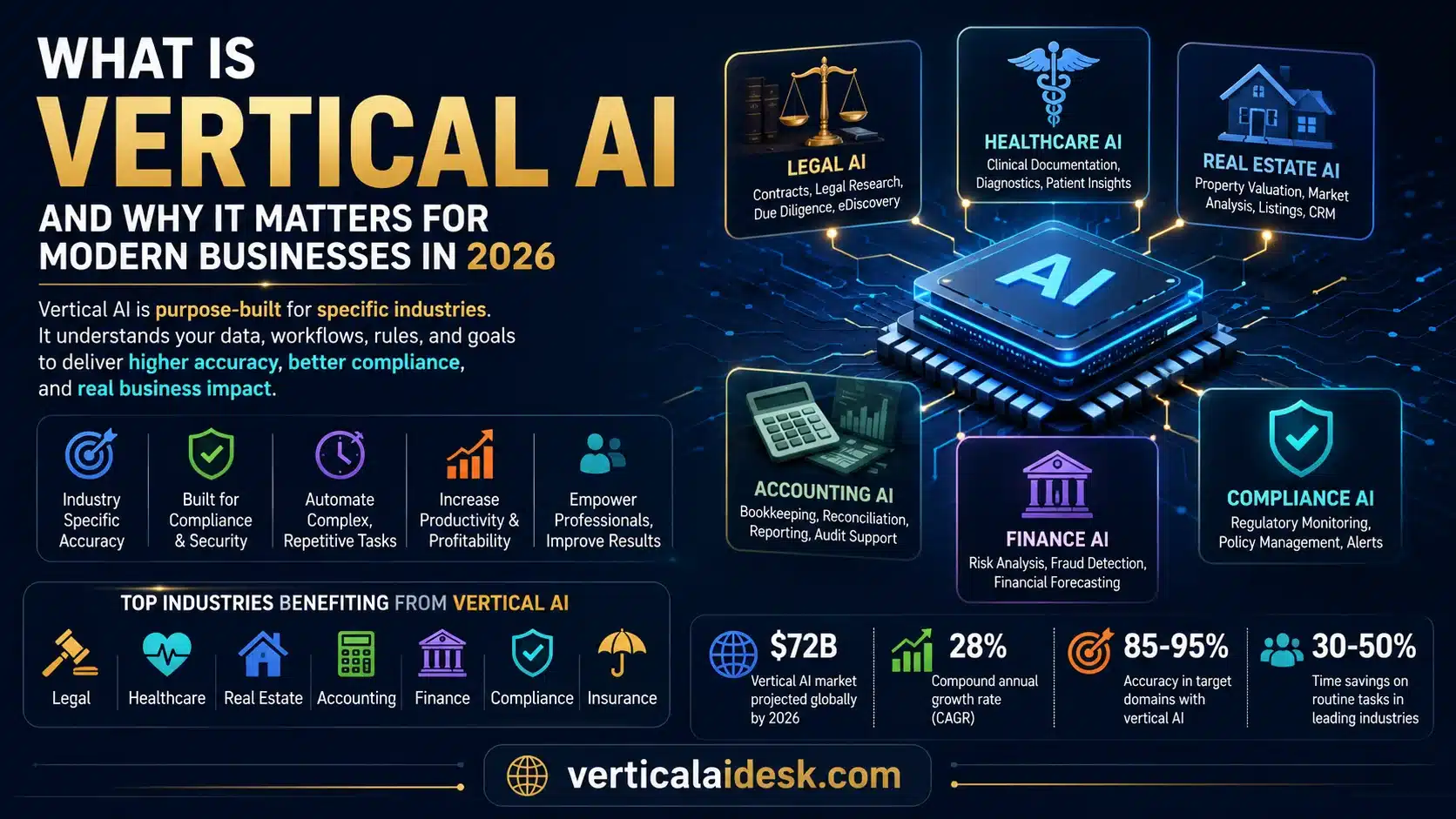
WHAT IS VERTICAL AI AND WHY IT MATTERS FOR MODERN BUSINESSES IN 2026
Table of Contents
Introduction
Artificial intelligence has moved far beyond the experimental phase. In 2026, businesses are no longer asking whether they should adopt AI. They are asking which type of AI will deliver the best results for their specific needs. This is where vertical AI enters the conversation. Unlike general purpose AI tools that try to serve everyone, vertical AI is purpose built for individual industries. It understands the language, regulations, workflows, and data structures unique to sectors like legal, healthcare, real estate, accounting, and finance. This article explains what vertical AI is, how it differs from general AI, why it matters for modern businesses, and which industries are seeing the most impact.
What Is Vertical AI
Vertical AI refers to artificial intelligence systems, models, and applications that are designed, trained, and optimized for a specific industry or professional domain. While general AI tools like ChatGPT or Claude can answer questions across many topics, vertical AI focuses on solving problems within one sector. For example, a legal AI tool is trained on millions of legal documents, case law, and contract templates. It understands legal terminology, jurisdiction specific rules, and the structure of legal workflows. A healthcare AI tool is trained on medical records, clinical guidelines, and diagnostic imaging. It understands medical terminology, patient privacy regulations, and clinical decision making processes.
The key difference lies in the training data and the intended use case. General AI models are trained on broad internet data. Vertical AI models are trained on curated, industry specific datasets. This specialized training allows vertical AI to deliver higher accuracy, better compliance, and more relevant outputs for professionals who need precision, not general knowledge.
How Vertical AI Differs from General AI
General AI tools are designed to be jacks of all trades. They can write poetry, summarize articles, generate code, and answer trivia questions. This versatility is impressive, but it comes with limitations. General AI often produces generic outputs that require significant human editing before they can be used in professional settings. It may miss industry specific nuances, use incorrect terminology, or fail to account for regulatory requirements.
Vertical AI, on the other hand, is a master of one domain. It is built with deep knowledge of industry standards, compliance frameworks, and professional workflows. A vertical AI tool for accounting does not just generate text about accounting. It understands GAAP principles, tax codes, and financial reporting standards. It can categorize transactions, flag anomalies, and generate audit ready reports. A vertical AI tool for real estate does not just describe properties. It understands MLS data, zoning regulations, and market comparables. It can generate listing descriptions, analyze market trends, and predict property values.
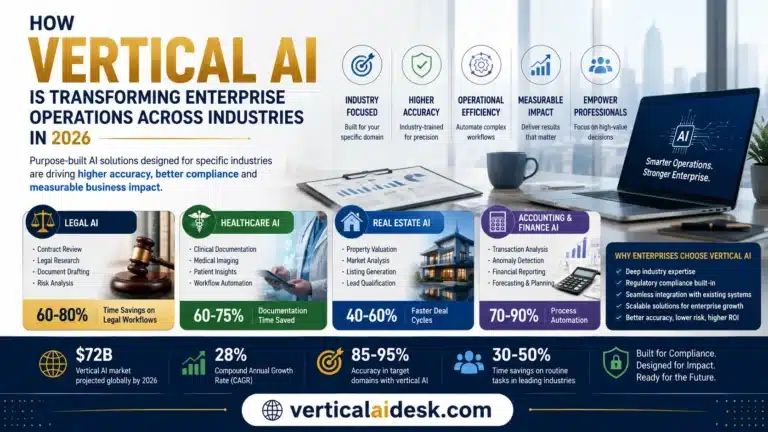
The performance gap is measurable. According to industry research, vertical AI tools achieve accuracy rates of 85 to 95 percent in their target domains, compared to 60 to 75 percent for general AI tools on the same tasks. For businesses where errors carry financial or legal consequences, this difference is not just significant. It is essential.
Why Vertical AI Matters for Modern Businesses in 2026
The business landscape in 2026 is defined by specialization, regulation, and competition. Companies that operate in regulated industries cannot afford to use tools that do not understand compliance requirements. Law firms need AI that understands attorney client privilege and confidentiality rules. Healthcare providers need AI that understands HIPAA and clinical standards. Financial institutions need AI that understands SEC regulations and anti money laundering protocols.
Vertical AI matters because it bridges the gap between AI potential and industry reality. It allows businesses to automate complex, knowledge intensive tasks without sacrificing accuracy or compliance. It reduces the time professionals spend on repetitive work, allowing them to focus on high value activities that require human judgment and creativity.
In 2026, the vertical AI market is projected to reach 72 billion dollars globally, growing at a compound annual growth rate of 28 percent according to market research firms. This growth is driven by increasing demand from enterprises that have tried general AI tools and found them insufficient for their specialized needs.
Industries Where Vertical AI Is Making the Biggest Impact
Legal Industry
The legal sector has been one of the earliest and most enthusiastic adopters of vertical AI. Legal AI tools can review contracts in minutes instead of hours, identify risky clauses, compare terms against standard templates, and flag deviations from preferred language. They can conduct legal research by analyzing thousands of case law documents and extracting relevant precedents. They can draft standard documents like NDAs, employment agreements, and lease contracts with minimal human input.
Law firms using vertical AI report time savings of 30 to 50 percent on routine tasks. This translates to lower costs for clients and higher margins for firms. Solo practitioners and small law firms benefit the most, as they gain access to capabilities that were previously only available to large firms with extensive support staff.
Healthcare and Medical Industry
Healthcare vertical AI is transforming how doctors diagnose diseases, manage patient records, and deliver care. AI medical scribing tools listen to patient consultations and generate clinical notes automatically, reducing documentation time by up to 70 percent. AI diagnostic tools analyze medical imaging, pathology slides, and lab results to detect conditions like cancer, diabetic retinopathy, and cardiovascular disease with accuracy that matches or exceeds human specialists.
Healthcare providers using vertical AI report improved patient outcomes, reduced burnout among clinical staff, and faster turnaround times for diagnoses. The technology is particularly valuable in underserved areas where specialist expertise is scarce.
Real Estate Industry
Real estate vertical AI helps agents, brokers, and property managers work more efficiently and close more deals. AI tools can generate compelling property descriptions, analyze market trends to predict pricing, identify qualified leads from online behavior, and automate follow up communications. AI property valuation tools analyze comparable sales, market conditions, and property features to generate accurate valuations in seconds.
Real estate professionals using vertical AI report listing faster, pricing more accurately, and spending more time on client relationships instead of administrative tasks. In competitive markets, this advantage can mean the difference between winning and losing listings.
Accounting and Finance Industry
Accounting vertical AI automates bookkeeping, expense categorization, invoice processing, and financial reporting. It can reconcile accounts, detect fraud, and generate audit trails with minimal human intervention. AI financial forecasting tools analyze historical data, market trends, and economic indicators to project future revenue, cash flow, and profitability.
Accounting firms and finance departments using vertical AI report processing transactions 5 to 10 times faster than manual methods. They also report fewer errors and improved compliance with tax regulations and financial reporting standards.
SaaS and Automation
Vertical AI is also transforming the software industry itself. AI powered SaaS automation tools help businesses automate workflows, integrate applications, and manage data across platforms. These tools use natural language processing to understand user requests, machine learning to optimize processes, and predictive analytics to anticipate needs before they arise.
Businesses using AI powered SaaS automation report saving 15 to 20 hours per week on repetitive tasks. They also report improved data accuracy, faster decision making, and better customer experiences.
Key Benefits of Vertical AI for Businesses
Accuracy and Precision
Vertical AI delivers higher accuracy because it is trained on domain specific data. It understands the context, terminology, and standards of the industry it serves. This reduces errors, minimizes rework, and improves the quality of outputs.
Compliance and Risk Management
Vertical AI is built with regulatory requirements in mind. It understands data privacy laws, industry standards, and compliance frameworks. This reduces the risk of violations, fines, and reputational damage.
Efficiency and Productivity
By automating routine, knowledge intensive tasks, vertical AI frees professionals to focus on strategic, creative, and relationship building activities. This improves job satisfaction and business outcomes.
Competitive Advantage
Businesses that adopt vertical AI early gain a significant competitive advantage. They can deliver faster, more accurate, and more compliant services than competitors who rely on manual processes or general purpose tools.
Challenges and Considerations
Despite its benefits, vertical AI is not without challenges. Implementation requires careful planning, data preparation, and change management. Organizations must ensure that their data is clean, structured, and accessible. They must train employees to work alongside AI tools rather than resist them. They must also address concerns about job displacement by redefining roles to focus on higher value activities.
Data privacy and security are critical concerns, especially in regulated industries. Organizations must choose vertical AI vendors that comply with industry standards and provide robust security measures.
Cost is another consideration. Vertical AI tools can be more expensive than general AI tools because of their specialized development and training. However, the return on investment is typically higher due to improved accuracy, compliance, and efficiency.
The Future of Vertical AI
Looking ahead, vertical AI will become even more integrated into business operations. We can expect to see more industry specific AI models, better interoperability between tools, and more intuitive user interfaces that require minimal technical expertise. As the technology matures, the cost of implementation will decrease, making vertical AI accessible to small and medium sized businesses, not just large enterprises.
The convergence of vertical AI with other technologies like blockchain, Internet of Things, and edge computing will create new possibilities for automation, transparency, and real time decision making.
Conclusion
Vertical AI is not just a trend. It is a fundamental shift in how businesses adopt and benefit from artificial intelligence. By focusing on specific industries and domains, vertical AI delivers the accuracy, compliance, and efficiency that general AI cannot match. For modern businesses in 2026, the question is no longer whether to adopt AI, but whether to choose tools that truly understand their industry. Vertical AI is the answer.
FAQ
What is vertical AI in simple terms
Vertical AI is artificial intelligence built specifically for one industry, like legal, healthcare, or real estate. It understands the language, rules, and workflows of that industry better than general AI.
How is vertical AI different from general AI
General AI is designed to work across many topics and tasks. Vertical AI is designed for one specific industry, making it more accurate and relevant for professional use.
Which industries benefit most from vertical AI
Legal, healthcare, real estate, accounting, finance, and software automation are seeing the biggest benefits from vertical AI in 2026.
Is vertical AI more expensive than general AI
Vertical AI tools can cost more upfront due to specialized development. However, they typically deliver a higher return on investment through better accuracy and compliance.
Can small businesses use vertical AI
Yes. Many vertical AI tools are now available as affordable SaaS subscriptions, making them accessible to small businesses and solo practitioners.
What are examples of vertical AI tools
Examples include Harvey AI for legal work, Nuance Dragon Medical for healthcare documentation, Zillow AI for real estate valuation, and QuickBooks AI for accounting automation.
How accurate is vertical AI compared to general AI
Vertical AI typically achieves 85 to 95 percent accuracy in its target domain, compared to 60 to 75 percent for general AI on the same tasks.
Will vertical AI replace human workers
No. Vertical AI automates routine tasks but still requires human oversight, judgment, and creativity. It augments human capabilities rather than replacing them.
One Comment