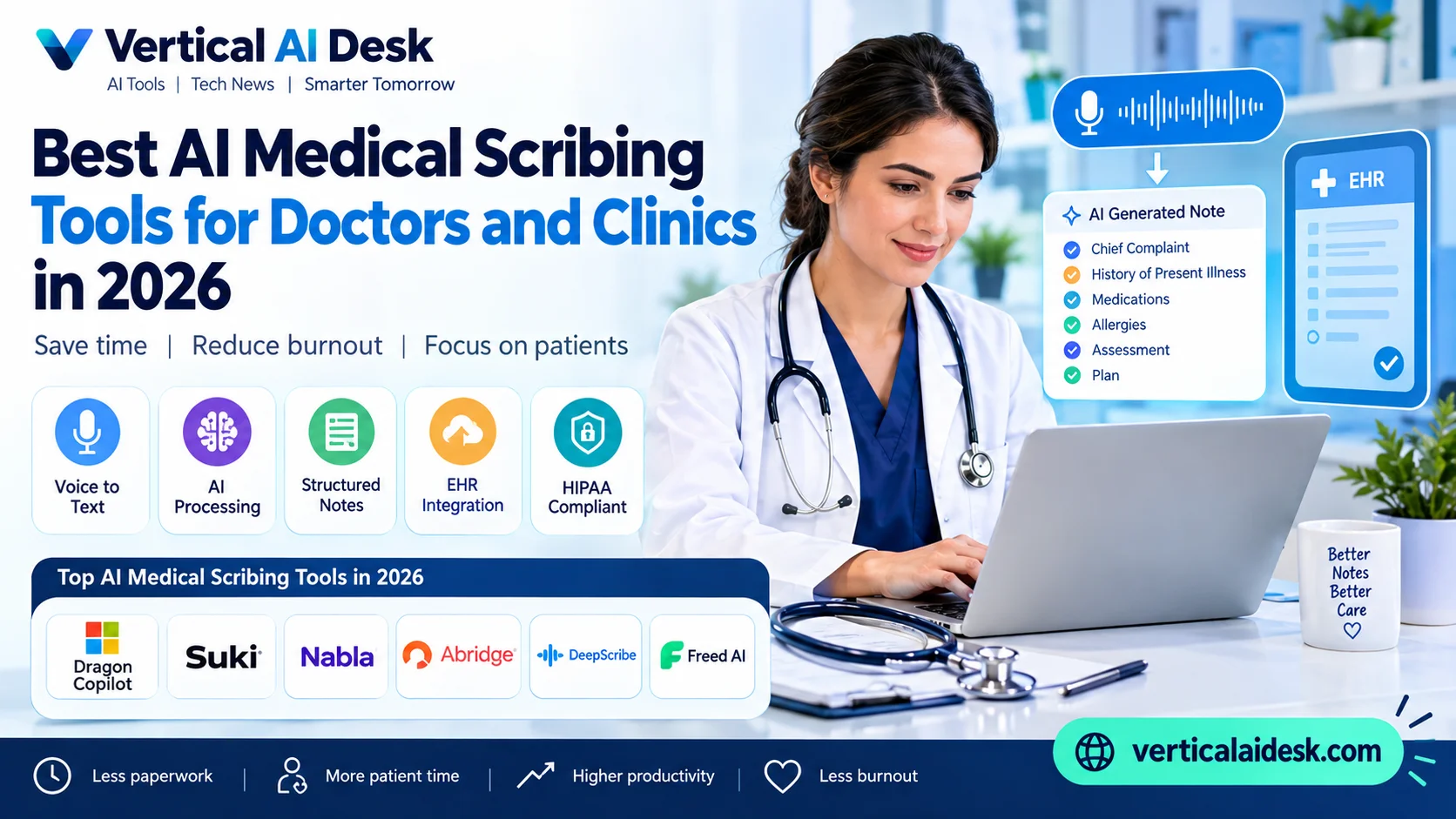
Best AI Medical Scribing Tools for Doctors and Clinics in 2026
Ask any physician what eats up their day and documentation comes up almost immediately. A well-known 2016 study in the Annals of Internal Medicine, led by Christine Sinsky at the AMA, found that for every hour doctors spend face to face with patients, they spend close to two hours on the EHR and other desk work. Ten years and thousands of software updates later, that ratio hasn’t improved much for a lot of practices.
AI medical scribing tools are the industry’s current answer to that problem. They listen to a visit, or transcribe a dictation, and turn it into a structured note the physician reviews and signs. Interest in AI doctor note taking has grown right alongside physician burnout numbers, and for good reason. We put this comparison together from vendor documentation, public pricing pages, KLAS and industry reporting, and the handful of peer-reviewed studies that actually exist on this category, rather than running our own side-by-side lab test. Where a vendor doesn’t publish real numbers, and most of them don’t, we say so instead of inventing one.
Table of Contents
Why Documentation Still Eats the Day
The Sinsky study wasn’t a one-off finding. Physicians in that research spent 27 percent of their day in direct clinical face time and 49 percent on EHR and desk work, with another one to two hours most nights spent catching up. That kind of load compounds. The AMA’s most recent National Physician Comparison Report puts physician burnout at 41.9 percent in 2025, genuinely encouraging progress from the pandemic-era peak of 62.8 percent in 2021, though Medscape’s separate survey, which uses a broader definition, still puts the figure above 60 percent. Either way, physicians consistently name EHR burden and bureaucratic work as the top drivers.
AI medical scribe software doesn’t erase that burden. What it does, when it works, is shift documentation from something a doctor does after hours to something that happens mostly during or right after the visit, with a few minutes of editing instead of twenty.
How AI Medical Scribes Actually Work
Most tools in this category combine three layers. Speech recognition converts the audio into text, tuned on medical vocabulary so it handles drug names and anatomical terms better than a general transcription app would. This is the backbone of medical AI transcription generally. Natural language processing then sorts that text into clinical categories: symptoms, history, medications, allergies, assessment, plan. On top of that sits some form of clinical reasoning that decides what goes where in a SOAP note or whichever format the practice uses, and in the better-integrated tools, pushes the finished note into the right fields in the EHR instead of leaving you to copy and paste it. That combination is what people mean by automated clinical documentation, and it has improved noticeably since the category’s early days.
None of that removes the physician from the loop. Every vendor in this space, without exception, expects the clinician to review and sign off on the note before it becomes part of the record. Treat any product that implies otherwise with some suspicion.
It’s also worth being clear about what these tools are not. A medical scribe writes down what happened in the room. It isn’t one of the AI diagnostic tools in healthcare that suggests a diagnosis or flags a risk on its own, and mixing those two categories up leads to disappointment either way.
The Six Tools Worth Knowing in 2026
The market has more than fifty AI scribe vendors competing for attention at this point, so we focused on six that come up constantly in health system RFPs and independent practice searches alike, from the enterprise end down to the solo-clinician end.
Microsoft Dragon Copilot (and Where Dragon Medical One Fits)
This is the one that causes the most confusion, so it’s worth untangling. Dragon Medical One is Nuance’s older dictation product. The clinician talks, the software transcribes exactly what’s said, and there’s no passive listening during the visit. Dragon Copilot is different. Microsoft folded Nuance’s ambient product, previously sold as DAX Copilot, together with Dragon Medical One’s dictation engine into a single unified product in March 2025, built on Azure OpenAI Service. If you’re comparing tools that listen to the actual conversation and draft a note without you dictating, Dragon Copilot, not Dragon Medical One, is the product you want.
Dragon Copilot is now used by more than 100,000 clinicians across nine countries, with named health system deployments including Mount Sinai and Tampa General Hospital. It carries HITRUST certification and runs on Microsoft’s healthcare compliance infrastructure. Microsoft doesn’t publish list pricing. It sells through direct sales reps and Cloud Solution Provider resellers on 12-month contracts, and one authorized reseller has quoted small-practice licensing around $160 per user per month plus a one-time implementation fee, while broader industry estimates for enterprise Epic deployments run closer to $500 to $600 per provider per month. Get an actual quote before assuming either number applies to you.
Suki AI
Suki bills itself as a clinical assistant rather than a passive scribe, and the feature set backs that up. Beyond ambient note generation, it handles voice commands for pulling up patient data, dictating letters, staging orders, and running ICD-10 and HCC coding suggestions, triggered by spoken commands during or after the visit. It connects to four EHRs: Epic, Oracle Health, athenahealth, and MEDITECH.
Suki doesn’t publish pricing on its site. You talk to sales, and industry reporting consistently puts the range at $299 to $399 per provider per month, positioning it toward larger practices and health systems rather than solo clinicians comparing self-serve options. One AAFP-published study found a meaningful reduction in documentation burden for the primary care physicians in that study, though it’s a single study rather than a broad evidence base.
Nabla
Nabla is the tool with the strongest independent evidence behind it, which matters more than any marketing copy. As of 2026 it’s deployed across roughly 130 to 150 health organizations and used by more than 85,000 clinicians, processing about 20 million encounters a year. It ships two separate products, Nabla Copilot for ambient note generation and Nabla Dictation for real-time voice-to-text at the cursor, and either can run standalone or together. EHR integrations cover Epic, athenahealth, Oracle Health, NextGen, and Greenway Health, and the platform supports more than 35 languages, including Haitian Creole and several South and East Asian languages, a genuine differentiator for practices serving diverse patient populations.
Nabla was one of two tools studied in the first randomized controlled trial of AI scribes, published in NEJM AI in 2025. More on that a bit further down. Pricing isn’t published, though a free tier with volume limits exists alongside paid tiers reached through a sales conversation.
Abridge
Abridge is the best-funded and most institutionally credentialed name on this list. Cardiologist Shiv Rao and former Carnegie Mellon machine learning professor Zach Lipton founded the company in Pittsburgh in 2018. It has since raised roughly $812 million, reaching a $5.3 billion valuation after a Series E round led by Andreessen Horowitz and Khosla Ventures, and it’s deployed at more than 250 health systems, including Mayo Clinic, Duke Health, Johns Hopkins and Kaiser Permanente. KLAS Research named it the top ambient AI platform two years running, in 2025 and 2026.
Its most distinctive feature, and one worth calling out specifically, links every section of a generated note back to the exact transcript and audio segment that produced it, which gives clinicians a way to check a note against the actual conversation instead of trusting it blindly. Abridge also auto-generates a patient-facing after-visit summary written at an eighth-grade reading level, available in more than 28 languages. The catch is access. There’s no self-serve signup, no individual pricing tier, and no free trial. It sells exclusively to health systems through a procurement process that independent reviews put at three to six months, with reported per-provider costs anywhere from roughly $200 to $800 or more per month depending on contract scope.
DeepScribe
DeepScribe started in 2017 as a general ambient scribe and has narrowed its focus hard toward oncology and other specialty care since. Partnerships with Flatiron Health’s OncoEMR and Ontada’s iKnowMed now anchor its EHR integration story, and the company says its AI is on track to document more than 3 million cancer care visits a year. Features include SmartPrep, which pulls together a patient’s history, labs, and imaging before the visit even starts, AI-assisted coding, and a customization studio for tailoring note structure. One thing sets it apart from most of this list: every note goes through a human quality-assurance review before it reaches the clinician, not just an AI pass.
Pricing is quote-only. Independent estimates place it somewhere between $350 and $750 a month per provider depending on the source, which puts it well above the self-serve tier and roughly in line with Suki. If your practice isn’t in oncology or another specialty DeepScribe has built for, a broader tool is probably a better fit anyway.
Freed AI
Freed sits at the opposite end of the market from Abridge and DeepScribe. Two former Facebook engineers, Erez Druk and Andrey Bannikov, founded it in San Francisco in 2022, and it has grown into one of the most widely adopted AI scribes among solo and small-group practices, with more than 20,000 paying clinicians processing close to 3 million visits a month across over a thousand small healthcare organizations.
Pricing is actually published, which is rare on this list: a Starter plan at $39 a month capped at 40 notes, a Core plan at $79 a month with unlimited notes, and a Premier plan at $119 a month, or $104 billed annually, that adds EHR push and ICD-10/CPT coding, both missing from the cheaper tiers. There’s a seven-day free trial with no credit card required. Freed doesn’t store patient recordings, transcribes in more than 90 languages, and has recently branched into an AI receptionist add-on called Front Desk. Worth knowing if budget matters to you: Doximity launched a free ambient scribe for verified U.S. physicians in the past year, and that kind of pressure is likely to keep pushing prices in this tier down further.
The Comparison, Side by Side
| Tool | Best Known For | Access Model | Reported Starting Price |
| Microsoft Dragon Copilot | Deep Epic integration, Microsoft-backed infrastructure | Enterprise sales, 12-month contracts | ~$160/mo (small-practice reseller quote) to $500+/mo (enterprise) |
| Suki AI | Voice-command assistant beyond note-taking | Enterprise sales, quote only | $299 to $399/mo, industry-reported |
| Nabla | Broadest language support, only tool in a published RCT | Free tier plus enterprise sales | Free tier available; paid tiers unpublished |
| Abridge | Deepest health system credibility, transcript-linked notes | Enterprise only, no self-serve | $200 to $800+/mo, industry estimates |
| DeepScribe | Oncology and specialty-care focus, human QA review | Enterprise sales, quote only | $350 to $750/mo, industry estimates |
| Freed AI | Transparent tiered pricing, fastest self-serve setup | Self-serve signup, 7-day free trial | $39 to $119/mo, published |
What the Only Randomized Trial So Far Actually Found
Nearly everything in this category is vendor-reported. One study stands apart. In 2025, researchers ran the first randomized controlled trial of AI medical scribes, enrolling 238 outpatient physicians across 14 specialties at UCLA Health and publishing the results in NEJM AI. The trial compared two of the tools covered here, Nabla and the DAX ambient product now folded into Dragon Copilot, against a no-scribe control group.
The results were more nuanced than either vendor’s marketing suggests. Nabla produced a modest but statistically meaningful reduction in physicians’ time spent writing notes. The DAX-based tool did not show a meaningful reduction on that same measure. Both tools, though, improved physician burnout and task load scores compared with the control group, and the researchers noted occasional inaccuracies in the notes from both systems, which is exactly why every vendor still requires physician review before a note gets signed off. If you take one data point from this whole article, that trial is the one worth remembering, since it’s the rare finding in this space that didn’t come from a vendor’s own press release.
Choosing the Right Tool for Your Practice
The honest starting point is your practice size, because it determines which half of this list you’re even shopping in. Solo clinicians and small groups get real, published pricing and same-day signup from Freed and similar self-serve tools. Health systems and larger group practices are the actual customers for Abridge, DeepScribe, Suki, and enterprise Dragon Copilot deployments, and none of those four will quote you a price without a sales conversation.
EHR compatibility comes right after budget. A tool that can’t push notes into your specific EHR, whether that’s Epic, athenahealth, Oracle Health, or something smaller, adds manual copy-paste work that erases a good chunk of the time savings you were hoping for.
Specialty fit matters more than most buyers expect going in. DeepScribe’s oncology-specific workflows will beat a generalist tool for a cancer center, the same way a broad multilingual base makes Nabla a better fit for a clinic seeing patients across a dozen language groups than a tool optimized for a single language and a single specialty. If voice commands during the visit genuinely fit how you already work, Suki’s assistant-style approach is worth the enterprise price tag in a way it might not be for a physician who just wants a clean note at the end of the visit.
Whatever you pick, plan on reviewing every note before it’s finalized. That’s not a limitation unique to one vendor. It’s a requirement across the entire category, and the one randomized trial we have found actual errors in both tools it tested.
Rolling It Out Without Wasting Six Months
A few things separate a smooth rollout from a stalled one. Start with a small pilot group instead of switching an entire practice at once, so problems surface before they’re expensive to fix. Budget real time for training, since even a well-designed tool takes a week or two before a physician’s editing time drops meaningfully. Set expectations early that AI scribes cut documentation time, they don’t eliminate the need to review what the AI wrote. Health IT groups like HIMSS have published general implementation guidance covering exactly this kind of rollout, including EHR integration checklists and staff training timelines, and it’s worth a look before your own pilot starts. Track something concrete too, whether that’s minutes spent charting, note-editing time, or a simple before-and-after satisfaction survey, so you have actual numbers instead of a general sense that things feel better.
Where This Leaves You
There isn’t a single best AI medical scribing tool for every practice, and any list that claims otherwise is selling something. Freed makes sense if you’re a solo or small-group clinician who wants published pricing and a same-day start. Nabla has the best independent evidence and the broadest language coverage. Abridge and DeepScribe fit specific enterprise and specialty niches respectively. Suki suits practices that want a voice-driven assistant, not just a scribe. Dragon Copilot makes the most sense if you’re already deep in Microsoft’s healthcare stack.
Whichever one you evaluate, ask for real numbers instead of accepting marketing claims, and budget time for your own pilot before committing to a system-wide rollout.
More AI Tool Reviews on VerticalAIDesk
Medicine isn’t the only field getting reshaped by task-specific AI right now. If you want the bigger picture first, our explainer on what is vertical AI covers why industry-specific tools like these tend to outperform general-purpose chatbots. And if healthcare isn’t your only interest, we’ve done the same kind of research on AI diagnostic tools in healthcare, the best AI contract review software for legal teams, AI tools for real estate agents, and AI accounting software for small businesses.
Frequently Asked Questions
What is an AI medical scribing tool?
It’s software that listens to or transcribes a patient encounter and generates a structured clinical note for the physician to review and sign, using speech recognition and natural language processing tuned for medical terminology.
How accurate are AI medical scribes?
Vendors rarely publish independently verified accuracy numbers. The one randomized controlled trial published so far, in NEJM AI in 2025, found occasional inaccuracies in both tools it tested, which is why physician review before sign-off is standard across every product in this category, not optional.
Do AI medical scribes replace human scribes?
They can replace human scribes for many practices, particularly where cost or scheduling makes a live scribe impractical. Physician review of the generated note is still required either way.
Are AI medical scribes HIPAA compliant?
The tools covered here all claim HIPAA compliance, and most carry additional certifications like SOC 2 or HITRUST. Ask any vendor for their business associate agreement and current compliance documentation before signing anything.
How much do AI medical scribing tools cost?
It varies enormously by access model. Freed publishes tiered pricing from $39 to $119 a month. Suki and DeepScribe are typically reported in the $300 to $750 monthly range. Abridge and enterprise Dragon Copilot deployments run into the hundreds of dollars per provider per month and require a sales conversation, since none of those four publish official pricing.
Can AI medical scribes handle multiple languages?
Several do. Nabla supports more than 35 languages, Abridge covers more than 28, and Freed and DeepScribe both claim support above 90. Coverage quality for less common languages still varies, so test with your actual patient population before committing.
Is there real research on whether AI scribes work?
Yes, though there’s less of it than the marketing volume suggests. The 2025 NEJM AI trial at UCLA Health is the first randomized study in the category and found mixed results between the two tools it tested, alongside improved burnout scores for both compared with a no-scribe control. Digital health journals including JMIR have also started publishing narrative reviews of ambient AI scribes as the evidence base catches up with vendor claims.
How long does implementation typically take?
For self-serve tools like Freed, a clinician can be documenting with the tool the same day. For enterprise platforms like Abridge or Dragon Copilot, procurement and EHR integration commonly take two to six months depending on the health system’s IT resources.