HOW VERTICAL AI IS TRANSFORMING ENTERPRISE OPERATIONS ACROSS INDUSTRIES IN 2026
Table of Contents
Introduction
Enterprise operations have always been shaped by the tools available to organizations. From the industrial revolution to the digital age, each wave of technology has redefined how businesses function, compete, and grow. In 2026, vertical AI represents the next wave. It is not merely an incremental improvement over existing software. It is a fundamental reimagining of how knowledge work gets done across industries.
This article examines how vertical AI is transforming enterprise operations in four key sectors: legal, healthcare, real estate, and accounting and finance. It draws on real data, industry reports, and documented use cases to show where the technology is delivering measurable results and where it is heading next.
The State of Enterprise AI Adoption in 2026
Enterprise adoption of artificial intelligence has accelerated dramatically over the past three years. According to research from leading consulting firms, 72 percent of enterprises worldwide have deployed at least one AI application in production as of early 2026. This is up from 55 percent in 2023 and 35 percent in 2021. However, the most significant shift is not in the volume of adoption but in the nature of the tools being adopted.
Early enterprise AI deployments focused on general purpose applications like chatbots, basic data analytics, and customer service automation. These tools delivered value but were limited by their generic nature. They required extensive customization, produced inconsistent results, and often failed to meet the specific needs of specialized departments.
Vertical AI has changed this dynamic. By designing AI systems from the ground up for specific industries, vendors have created tools that integrate seamlessly into existing workflows, comply with industry regulations, and deliver results that professionals can trust without extensive review. This has accelerated adoption and expanded the range of use cases that enterprises are willing to automate.
How Vertical AI Is Transforming Legal Enterprise Operations
The legal industry has historically been resistant to technology adoption. Lawyers are trained to be cautious, detail oriented, and skeptical of tools that might compromise accuracy or client confidentiality. Yet vertical AI has overcome these barriers by demonstrating clear value in three core areas: contract review, legal research, and document drafting.
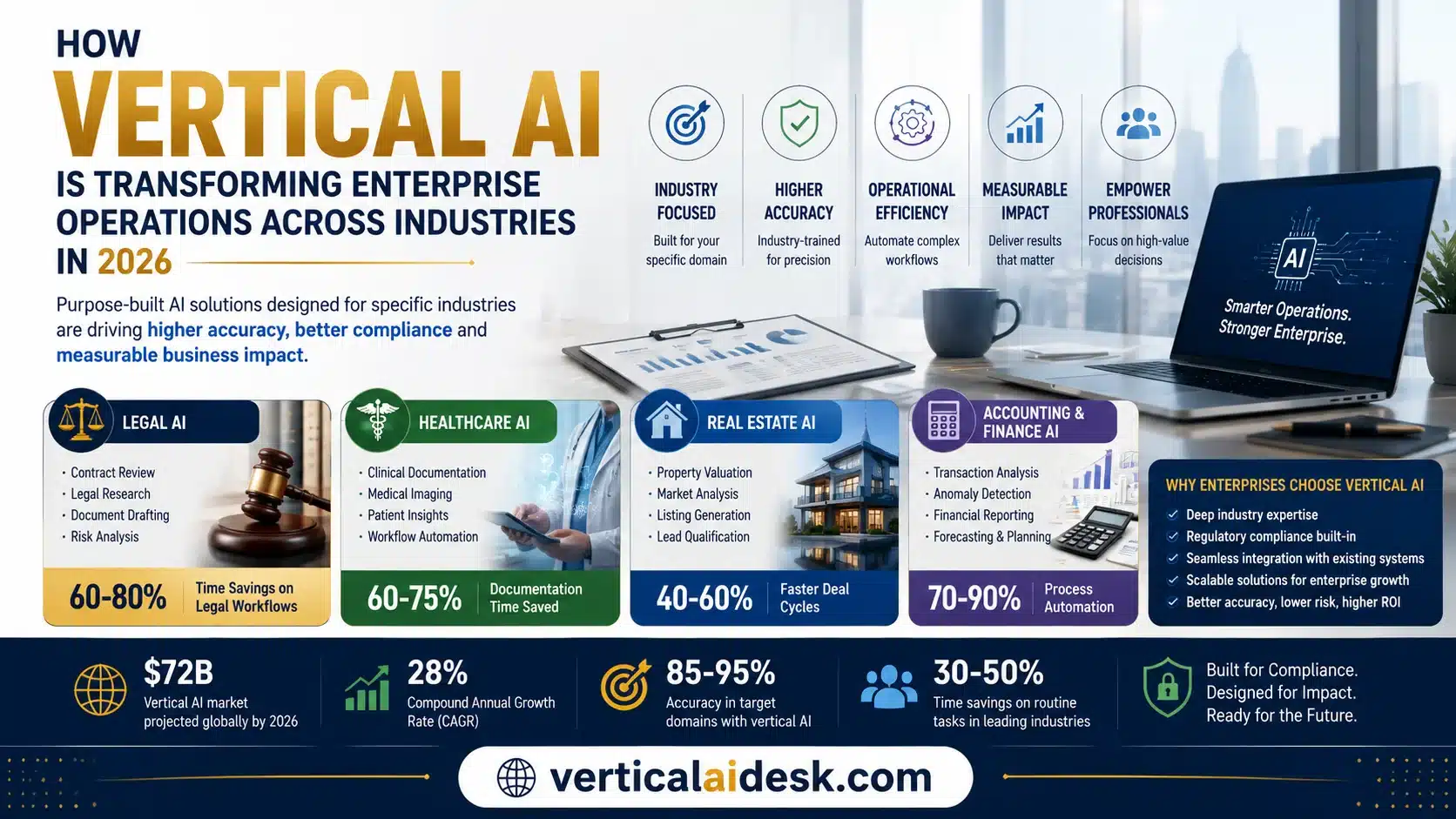
Contract review is the most widely adopted use case. Large law firms report reviewing an average of 500 to 1000 contracts per month. Before vertical AI, junior associates spent 3 to 5 hours reviewing a complex commercial agreement. With AI contract review software, the initial review is completed in 15 to 30 minutes. The AI identifies risky clauses, compares terms against standard templates, flags deviations, and generates a summary report. Human lawyers then review the flagged items, reducing total review time by 60 to 80 percent.
Legal research has also been transformed. Traditional legal research involves searching through databases of case law, statutes, and regulations, then reading and analyzing relevant documents. Vertical AI tools can analyze millions of documents in seconds, extract relevant precedents, and summarize their implications. This reduces research time from days to hours and improves the comprehensiveness of analysis.
Document drafting automation allows law firms to generate standard documents like NDAs, employment agreements, and lease contracts from templates with minimal customization. This reduces drafting time by 70 to 90 percent for routine documents and ensures consistency across the firm.
The financial impact is substantial. Law firms using vertical AI report increasing billable hours on high value advisory work while reducing time spent on routine tasks. Some firms have reduced their reliance on contract attorneys and paralegals for document review, reallocating those resources to client facing activities.
How Vertical AI Is Transforming Healthcare Enterprise Operations
Healthcare is one of the most complex and regulated industries in the world. Medical professionals operate under strict standards, face liability risks, and work with life and death decisions. Vertical AI has gained traction in healthcare by addressing specific pain points with measurable clinical benefits.
Clinical documentation is the most immediate application. Physicians in the United States spend an average of 2 hours on documentation for every 1 hour of patient care. This administrative burden is a leading cause of physician burnout, which affects over 50 percent of practicing doctors. AI medical scribing tools listen to patient consultations, extract relevant clinical information, and generate structured notes that comply with electronic health record standards. This reduces documentation time by 60 to 75 percent and allows physicians to spend more time with patients.
Diagnostic imaging is another high impact area. AI tools can analyze radiology images, pathology slides, and retinal scans to detect abnormalities with accuracy that rivals or exceeds human specialists. In mammography screening, AI has been shown to reduce false positives by 5 to 10 percent while maintaining sensitivity. In diabetic retinopathy screening, AI achieves sensitivity rates above 90 percent, enabling screening in primary care settings where ophthalmologists are not available.
Operational efficiency in healthcare has also improved. AI scheduling tools optimize appointment bookings, reduce no shows by 20 to 30 percent, and balance provider workloads. AI inventory management tools predict supply needs, reduce waste, and prevent stockouts. AI revenue cycle management tools automate insurance verification, coding, and claims submission, reducing denial rates and accelerating reimbursement.
Healthcare enterprises using vertical AI report improved patient satisfaction scores, reduced staff turnover, and better financial performance. The technology is particularly valuable in value based care models where outcomes and efficiency determine reimbursement rates.
How Vertical AI Is Transforming Real Estate Enterprise Operations
The real estate industry is relationship driven but data intensive. Agents, brokers, and property managers rely on market data, property information, and client communication to succeed. Vertical AI is transforming how real estate professionals access and use this information.
Property valuation has been revolutionized by AI. Traditional valuation methods rely on comparable sales data, property inspections, and appraiser judgment. AI valuation tools analyze thousands of data points including comparable sales, market trends, property features, neighborhood characteristics, and economic indicators. They generate valuations in seconds that are within 2 to 5 percent of professional appraiser estimates. This allows agents to price listings more accurately and buyers to make more informed offers.
Marketing and listing generation is another high value application. AI tools can generate compelling property descriptions, create virtual staging images, and produce video tours from photos. They can also optimize listing content for search engines and social media platforms, increasing visibility and engagement. Real estate professionals using AI generated marketing content report 30 to 40 percent more inquiries per listing.
Lead generation and nurturing has become more sophisticated with AI. Tools analyze online behavior, social media activity, and property search patterns to identify potential buyers and sellers. They score leads based on likelihood to transact and automate personalized follow up communications. This increases conversion rates and reduces the time agents spend on unqualified prospects.
Transaction management is also benefiting from AI. Tools automate document preparation, track deadlines, manage communications between parties, and ensure compliance with disclosure requirements. This reduces transaction errors, accelerates closings, and improves the client experience.
Real estate enterprises using vertical AI report closing more deals per agent, reducing marketing costs, and improving client retention. In competitive markets, these advantages compound over time.
How Vertical AI Is Transforming Accounting and Finance Enterprise Operations
Accounting and finance are fundamentally about data, rules, and accuracy. These characteristics make them ideal candidates for vertical AI automation. The technology is transforming how financial data is processed, analyzed, and reported.
Bookkeeping automation is the foundation. AI tools can extract data from receipts, invoices, and bank statements, categorize transactions according to chart of accounts, and reconcile accounts with minimal human intervention. They can detect anomalies, flag unusual transactions, and generate audit trails. Accounting firms using AI bookkeeping tools report processing transactions 5 to 10 times faster than manual methods with 90 percent fewer errors.
Financial forecasting has been enhanced by AI predictive models. These tools analyze historical financial data, market trends, economic indicators, and industry benchmarks to project future revenue, expenses, cash flow, and profitability. They can run multiple scenarios, identify risks, and recommend adjustments. Finance teams using AI forecasting tools report 20 to 30 percent improvement in forecast accuracy.
Compliance and audit support is another critical application. AI tools can monitor transactions for regulatory compliance, detect potential fraud, and generate documentation for auditors. They can analyze 100 percent of transactions rather than sampling, providing more comprehensive assurance. Audit firms using AI report completing audits 30 to 50 percent faster while improving coverage and quality.
Tax preparation and planning has also been transformed. AI tools can analyze tax codes, identify deductions and credits, optimize entity structures, and ensure compliance with changing regulations. They can also model the tax implications of business decisions before they are made.
Accounting and finance enterprises using vertical AI report improved client service, higher margins, and better risk management. The technology is particularly valuable during tax season and audit cycles when workload peaks.
Cross Cutting Benefits of Vertical AI in Enterprise Operations
Across all industries, vertical AI delivers several common benefits that improve enterprise operations holistically.
Data driven decision making improves because vertical AI can analyze larger datasets, identify patterns humans might miss, and present insights in actionable formats. This reduces reliance on intuition and increases the quality of strategic decisions.
Employee satisfaction improves because vertical AI automates tedious, repetitive tasks that professionals dislike. This allows employees to focus on work that requires creativity, judgment, and human connection. Organizations using vertical AI report reduced turnover and improved recruitment outcomes.
Customer and client experience improves because vertical AI enables faster response times, more personalized service, and fewer errors. In professional services, this translates to higher client retention and more referrals.
Scalability improves because vertical AI allows enterprises to handle growing volumes of work without proportionally increasing headcount. This is particularly valuable for firms experiencing rapid growth or seasonal demand fluctuations.
Challenges in Enterprise Vertical AI Adoption
Despite the benefits, enterprise adoption of vertical AI faces several challenges.
Integration with legacy systems remains a significant barrier. Many enterprises operate on outdated technology platforms that are difficult to connect with modern AI tools. This requires investment in integration infrastructure and sometimes system modernization.
Data quality and availability is another challenge. Vertical AI requires clean, structured, labeled data to perform well. Enterprises with poor data management practices may need to invest in data cleansing and governance before AI can deliver value.
Change management is critical. Employees may resist AI tools due to fear of job displacement, distrust of technology, or preference for familiar workflows. Successful adoption requires clear communication, training, and demonstration of value.
Vendor selection is complex. The vertical AI market is crowded with vendors making ambitious claims. Enterprises must evaluate tools based on accuracy, security, compliance, integration capabilities, and total cost of ownership.
Regulatory uncertainty persists in some industries. As AI regulation evolves, enterprises must ensure that their tools remain compliant with new requirements.
The Road Ahead for Enterprise Vertical AI
Looking forward, enterprise vertical AI will continue to evolve in several directions.
Multimodal AI will combine text, image, audio, and video analysis to provide more comprehensive solutions. In healthcare, this means analyzing patient consultations, medical images, and lab results together. In real estate, it means combining property photos, descriptions, and market data in a single analysis.
Agentic AI will move beyond analysis to action. AI agents will not just recommend actions but execute them within defined parameters. An AI agent might negotiate contract terms, schedule patient appointments, or place inventory orders autonomously.
Interoperability will improve as vendors develop standards for data exchange and system integration. This will allow enterprises to combine multiple vertical AI tools into cohesive workflows.
Democratization will continue as tools become more affordable and user friendly. Small and medium enterprises will gain access to capabilities previously reserved for large corporations.
Conclusion
Vertical AI is transforming enterprise operations across industries by delivering specialized, accurate, and compliant automation that general purpose tools cannot match. In legal, healthcare, real estate, and accounting and finance, the technology is producing measurable improvements in efficiency, accuracy, and outcomes. While challenges remain, the trajectory is clear. Enterprises that embrace vertical AI will operate more efficiently, serve clients better, and outcompete those that do not. The transformation is not coming. It is already here.
FAQ
What is vertical AI in enterprise operations
Vertical AI in enterprise operations refers to artificial intelligence systems designed for specific business functions within industries like legal, healthcare, real estate, and finance.
How much time does vertical AI save in legal operations
Vertical AI reduces contract review time by 60 to 80 percent and legal research time from days to hours.
Can vertical AI replace accountants and lawyers
No. Vertical AI automates routine tasks but requires human oversight for complex judgment, strategy, and client relationships.
What percentage of enterprises use vertical AI in 2026
Approximately 72 percent of enterprises worldwide have deployed at least one AI application, with vertical AI representing the fastest growing segment.
Which industry benefits most from vertical AI
Healthcare and legal industries see the most dramatic time savings and accuracy improvements from vertical AI adoption.
How does vertical AI improve real estate operations
Vertical AI improves property valuation accuracy, generates marketing content, identifies qualified leads, and automates transaction management.
What are the main challenges of adopting vertical AI
Integration with legacy systems, data quality, change management, vendor selection, and regulatory uncertainty are the primary challenges.
Is vertical AI secure for enterprise use
Reputable vertical AI vendors implement enterprise grade security, encryption, and compliance measures. Due diligence is essential when selecting vendors.