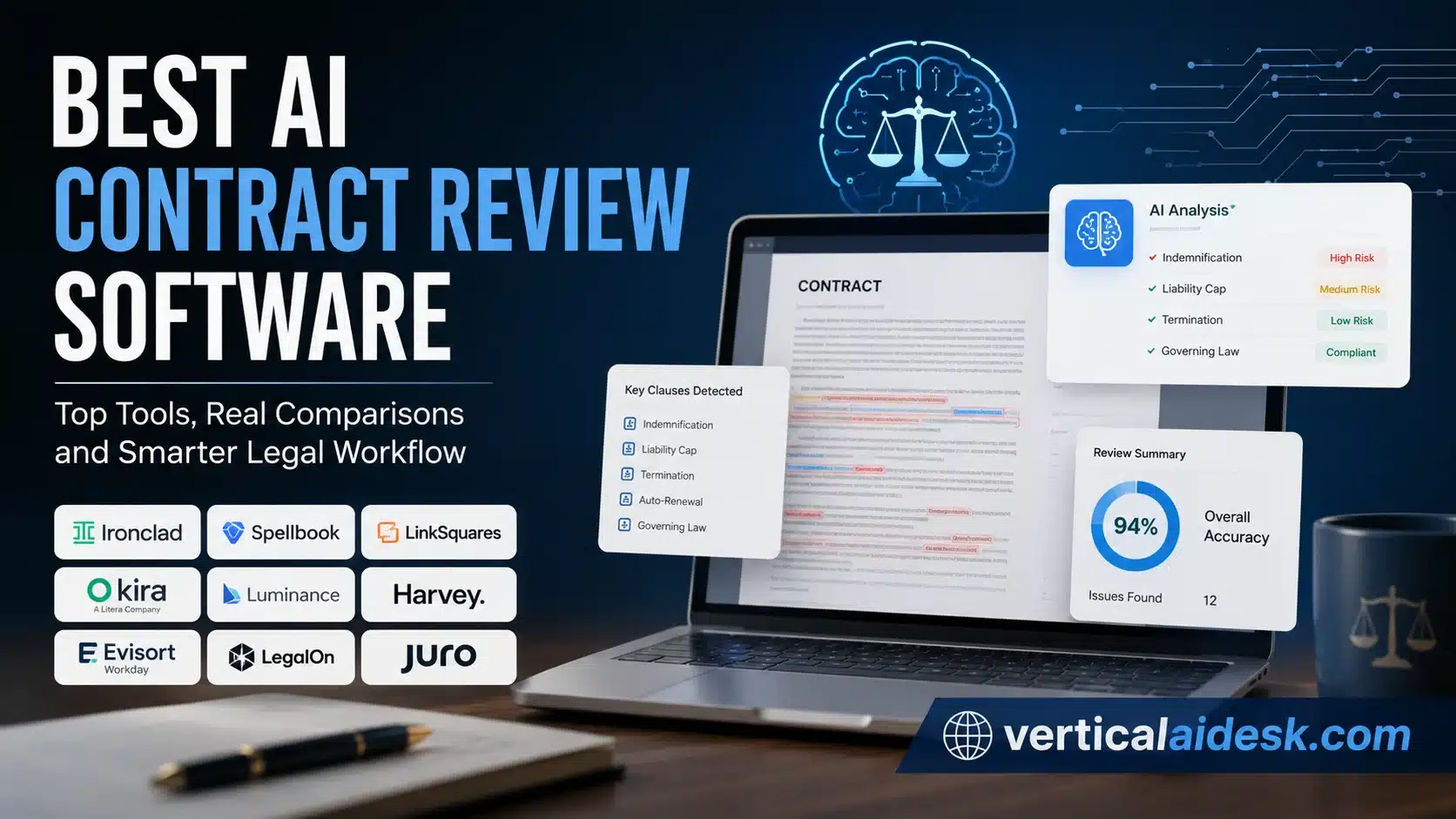
Best AI Contract Review Software in 2026: 9 Tools Compared for US Law Firms and Legal Teams
How we researched this: This guide is based on vendor pricing pages, product documentation, G2 and Capterra reviews and independent legal technology benchmark studies. We have not tested every product ourselves yet. When a number comes from a vendor’s own reporting rather than independent verification, we say so directly. We will add hands on trial notes as we get access to more of these platforms.
In 2018, LawGeex ran an experiment that legal technology researchers still talk about in 2026. Twenty experienced US corporate lawyers, including some with backgrounds at firms such as Alston & Bird and K&L Gates, went head to head against LawGeex’s AI software. They reviewed five non-disclosure agreements that none of them had seen before. The lawyers averaged 85% accuracy and took 92 minutes per contract. The AI averaged 94% accuracy and took just 26 seconds. That gap between speed and thoroughness is the whole reason AI contract review software exists, and it is why this has become one of the fastest-growing categories in legal technology.
Quick Answer: Best AI Contract Review Software by Use Case
- Best for solo and small firms: Spellbook. It redlines contracts and flags risk directly inside Microsoft Word.
- Best for in-house legal teams: Ironclad. It handles the full contract lifecycle along with playbook based review.
- Best for enterprise M&A due diligence: Kira Systems or Luminance. Both are built to read thousands of documents quickly.
- Best for post-signature contract analytics: LinkSquares. It offers repository search, obligation tracking and reporting.
- Best for BigLaw transactional work: Harvey AI, which is used across a majority of the Am Law 100.
- Best budget option for small teams: Juro or LegalOn. Both have a lighter setup and a lower entry price.
What Is AI Contract Review Software?
AI contract review software uses natural language processing and increasingly large language models, to read a contract. It pulls out key clauses such as indemnification, liability caps, termination rights, auto-renewal, and governing law and checks them against a playbook of your organization’s approved positions. Anything that falls outside those limits gets flagged. Instead of a lawyer reading every line of a routine NDA or vendor agreement, the software does a first pass in seconds and hands a human reviewer a short list of what actually needs attention.
How AI Contract Review Actually Works
- Ingestion and OCR. Scanned PDFs and Word documents are converted into text the software can actually read.
- Clause extraction. The model identifies and labels standard clause types, based on patterns it has learned from large volumes of legal text.
- Playbook comparison. Extracted clauses are checked against your organization’s pre-approved fallback positions.
- Risk flagging and redlining. Anything outside the playbook is flagged and scored by risk level. Some tools also suggest an alternative clause.
- Human review. Every credible platform in this category sends flagged items to a person for final sign-off. None of them are designed to run without supervision.
Why AI Contract Review Is Growing So Fast Right Now
Mordor Intelligence puts the generative AI segment of legal contract drafting and review at $4.21 billion in 2026, up from $3.34 billion in 2025. The firm projects this will reach $14.76 billion by 2031, which works out to a 28.52% annual growth rate. Separate research from Market.us estimates that roughly 42% of organizations are now implementing AI somewhere in their contracting process, with the US alone accounting for about $810 million of the North American market in 2025.
Adoption inside law firms is climbing too, though unevenly. The American Bar Association’s 2025 Legal Industry Report found that personal generative AI use among legal professionals reached 31%, up from 27% the year before. Firms with 51 or more lawyers reported 39% adoption of generative AI tools, roughly double the rate at firms with 50 or fewer lawyers. Thomson Reuters’ 2025 research separately put organization-level active use of generative AI in legal departments at 26%, nearly double the 14% reported in 2024.
Best AI Contract Review Software, Compared
| Tool | Best For | Notable Feature | Pricing Band |
| Ironclad | In-house teams, full lifecycle | Playbook review plus repository search | $30K to $200K+ per year |
| Spellbook | Solo and small firms | AI redlining inside Microsoft Word | $29 to $99 per user, monthly |
| LinkSquares | Legal ops, analytics | Post-signature repository reporting | About $31K median per year |
| Kira Systems (Litera) | M&A due diligence | 90%+ claimed accuracy on M&A docs | Custom, enterprise pricing |
| Luminance | Enterprise due diligence | Pattern recognition across large sets | Custom, enterprise pricing |
| Harvey AI | BigLaw transactional | Used across majority of Am Law 100 | $50K+ per attorney, per year |
| Evisort (Workday) | Workday-integrated orgs | Contract data extraction at scale | Priced as a Workday module |
| LegalOn | Mid-market in-house | Pre-built playbooks out of the box | $20K to $60K per year |
| Juro | Small legal or ops teams | Self-serve, browser-based, lighter setup | Low four figure entry |
These pricing bands are estimated from public, buyer side research and published case studies. They are not official rate cards, since most of these vendors sell through a custom sales process. Confirm current pricing directly before you budget for one.
The Tools, One by One
Ironclad
Ironclad is built as a full contract lifecycle platform rather than a simple review tool. Requesting, negotiating, signing and storing contracts all happen inside one system, with AI layered on top for playbook based review and repository search. Gartner has named it a Leader in its Contract Lifecycle Management Magic Quadrant. The tradeoff is that the same depth which makes it thorough also makes it slower to set up than a lighter tool and pricing runs from roughly $30,000 to over $200,000 a year depending on user count and modules, which puts it out of reach for most solo practitioners. It works best for in-house legal teams handling steady contract volume who want workflow automation, not just review.
Spellbook
Spellbook runs as an add-in inside Microsoft Word. It uses GPT-4 to suggest redlines, flag risk and draft alternative clause language while a lawyer works in the document they already have open. That no new platform to learn design is why it is the most commonly recommended pick for solo and small firm lawyers. Its limitation is scope. It works as a drafting and redlining assistant, not a full contract repository or lifecycle system, so larger legal departments tend to outgrow it. Entry level pricing runs from $29 to $99 per user per month. This is the right fit for solo and small firm lawyers who redline contracts directly in Word.
LinkSquares
LinkSquares focuses on what happens after a contract is signed. It offers a searchable repository, obligation tracking and reporting across your entire contract portfolio, along with AI assisted review. Reviewers on G2 consistently point to its speed and analytics as its strongest features. It is a weaker fit if your priority is pre-signature negotiation rather than post-signature visibility. Pricing is quote based and public, buyer side research puts the median annual contract at around $31,000, or roughly $2,500 to $3,500 per user per year. It suits legal operations teams that need reporting across an existing contract portfolio.
Kira Systems (now part of Litera)
Kira built its reputation on due diligence. It reads thousands of contracts quickly during mergers and acquisitions, real estate, or finance transactions and extracts the specific provisions a deal team needs. The company reports accuracy above 90% on M&A, real estate and finance contract types. In February 2026, Litera upgraded Kira’s due diligence engine and said it lets firms handle up to 10 times more reviews while holding 99% accuracy on risk detection. That figure comes from the vendor, so it is worth verifying against your own document set before you rely on it. It works best for firms running high volume M&A or real estate due diligence.
Luminance
Luminance uses pattern recognition AI to read and cluster large sets of documents. This puts it in the same due diligence category as Kira, particularly for teams working across multiple jurisdictions or languages. Like Kira, it is built for volume and speed on large document sets rather than a solo lawyer’s day to day contract queue and enterprise pricing reflects that. Choose this for cross border due diligence and large document set review.
Harvey AI
Harvey has moved fastest in BigLaw specifically. The company reports that over 100,000 lawyers across more than 1,300 organizations now use the platform, with a majority of the Am Law 100 among its customers and DLA Piper alone has expanded to 5,000 licenses. It is built for complex, multi document transactional and research work, not simple NDA triage. Pricing is enterprise only and reportedly starts above $50,000 per attorney per year, which is well outside most small and mid sized firm budgets. It works best for large firms doing complex transactional or cross jurisdictional work.
Evisort (now part of Workday)
Evisort built its name on contract data extraction at scale, pulling structured data out of large and messy contract repositories, before Workday acquired the company and folded it into the Workday platform as a module. That makes it a strong option if your organization already runs Workday for HR or finance and a less obvious choice if it does not, since it is now sold and priced as part of that broader suite. It works best for organizations already standardized on Workday.
LegalOn
LegalOn ships with pre-trained playbooks for common contract types, which shortens setup time compared to platforms where you have to build your own playbook from scratch. The company reports that customers see reductions of 70% to 85% in contract review time. That is a self-reported figure, so treat it as a starting benchmark rather than a guarantee for your own contract mix. Pricing sits in a mid market band, roughly $20,000 to $60,000 a year, based on published case studies. It works best for mid market in-house teams that want playbooks ready on day one.
Juro
Juro is a self-serve, browser based contract platform aimed at smaller legal teams that do not want a long, sales led implementation. It combines AI assisted review with e-signature and basic lifecycle management in one lighter tool, at a lower entry price than the enterprise CLM platforms above. It will not match Ironclad or LinkSquares on workflow depth at scale, but for a small team that just needs contracts reviewed and signed without a six figure commitment, that is a reasonable trade. It suits small legal or operations teams that want a fast, self-serve setup.
AI vs Human Lawyers: How Accurate Is It, Really?
The most cited data point in this category is still that 2018 LawGeex study and it is worth being upfront about that. The AI scored 94% accuracy in an average of 26 seconds per contract, against an 85% average and 92 minutes per contract for the 20 experienced lawyers, whose individual scores ranged from 67% to 100%. One 2026 industry benchmark roundup still calls it the most rigorous public study in the category, even eight years later. That says as much about how few controlled, independent studies exist in legal AI as it does about the result itself.
More recent data backs up the time savings side, even without repeating the same head to head format. A 2024 Deloitte analysis found that AI contract tools cut processing time by 25% to 50% overall, with high volume, repetitive contract types such as NDAs and MSAs seeing time savings above 75%. LegalOn separately reports that its own customers see reductions of 70% to 85% in review time. Again, that is a vendor-reported number, not an independent benchmark.
The honest takeaway is this. AI is faster than a human reviewer by a wide margin on standardized, high volume contract types and the accuracy data available suggests it is at least competitive with experienced lawyers on that category of document and in the LawGeex study, ahead of them. That is a different claim from saying AI is more accurate than lawyers on every contract, which the data does not support once you move into bespoke, heavily negotiated agreements.
Where AI Contract Review Still Falls Short
- Long, heavily negotiated contracts are the weak spot. General purpose language models show measurably more inaccuracies once a document runs past roughly 64,000 tokens. This means the longest and most heavily negotiated agreements are exactly where AI needs the closest human oversight, not the least.
- Hallucination risk is the top adoption blocker cited by the profession itself. The ABA’s 2024 Legal Technology Survey found that about 75% of respondents cite AI hallucinations as a significant concern and these are lawyers who are actively evaluating these tools, not skeptics on the sidelines.
- No credible tool operates without a human sign-off. Every platform covered here is built to flag and prioritize, not to approve a contract on its own. Any vendor pitching full autonomy on high stakes agreements deserves extra scrutiny.
- Data security matters as much as accuracy. Confirm the vendor’s current SOC 2 Type II status and ask directly whether your documents are used to train their models. Policies vary and change, so verify this at the time you buy, not from an old blog post, including this one.
How to Choose the Right Tool for Your Team
- By workflow. If you are a solo or small firm lawyer redlining contracts in Word, look at Spellbook. If you are an in-house team with steady contract volume, look at Ironclad. If your legal operations team needs reporting, look at LinkSquares.
- By use case. For routine review of NDAs and vendor agreements, playbook first tools like LegalOn are a good starting point. For due diligence at scale, consider Kira or Luminance. For complex BigLaw transactional work, consider Harvey.
- By budget. Entry level, per seat tools such as Spellbook and Juro start in the low hundreds to low thousands of dollars per year. Mid market platforms such as LegalOn and LinkSquares run from about $20,000 to $60,000 or more. Full enterprise contract lifecycle platforms such as Ironclad, Evisort and Harvey start around $30,000 and can exceed six figures.
- Before you sign anything. Run a trial using your own contracts, not the vendor’s demo documents. Accuracy claims depend heavily on how similar your contract language is to what the model was trained on.
Frequently Asked Questions
What is AI contract review software?
It uses natural language processing to read contracts, extract key clauses, compare them to your organization’s approved positions and flag anything outside those limits for a human to review.
How accurate is AI contract review compared to human lawyers?
In the most cited controlled study, LawGeex’s AI scored 94% accuracy against an 85% average for the 20 experienced lawyers reviewing the same NDAs. That result is specific to standardized contract types and the study is now several years old.
Can AI contract review software replace a lawyer?
No credible platform in this category is built to operate without a human sign-off. AI handles the first pass reading & flagging and a lawyer still makes the final call, especially on unusual or high stakes terms.
How much does AI contract review software cost?
Entry level tools for individual lawyers start around $29 to $99 per user per month. Mid market platforms typically run $20,000 to $60,000 a year. Full enterprise contract lifecycle platforms range from about $30,000 to well over $200,000 annually.
Is AI contract review software safe for confidential contracts?
It can be, but confirm the vendor’s current SOC 2 Type II status and ask explicitly whether your documents are used to train their models before uploading confidential agreements.
Which AI contract review software is best for small law firms?
Spellbook is the most commonly recommended option for solo and small firm lawyers because it works inside Microsoft Word with no separate platform to learn.
Which AI contract review software is best for enterprise legal teams?
Ironclad and LinkSquares are the most common choices for in-house teams handling volume, while Kira Systems and Luminance are purpose built for large scale due diligence.
Does AI contract review software work on scanned contracts?
Most platforms include OCR that converts scanned PDFs into machine readable text before analysis, though accuracy depends on scan quality.
The Bottom Line
There is no single best AI contract review tool. There is a best tool for your contract volume, your budget and the part of the lifecycle where you need the most help. Start with what you actually do most days. If you are redlining single contracts, start with Spellbook. If you are managing a repository, start with LinkSquares or Ironclad. If you are running due diligence at scale, start with Kira or Luminance. Whichever tool you shortlist, trial it on your own contracts before you sign an annual agreement and keep a lawyer in the loop on every flagged clause, because that is exactly how every platform in this comparison is designed to be used. For the rest of the AI toolkit available to law firms and legal teams, see our complete guide to Legal AI tools.
One Comment